Selected Work
Portfolio
A newsletter, a direct mail appeal, and two grant proposals, with the thinking behind each piece.
Newsletter / Winston-Salem Rescue Mission / 2025
A Story of Recovery
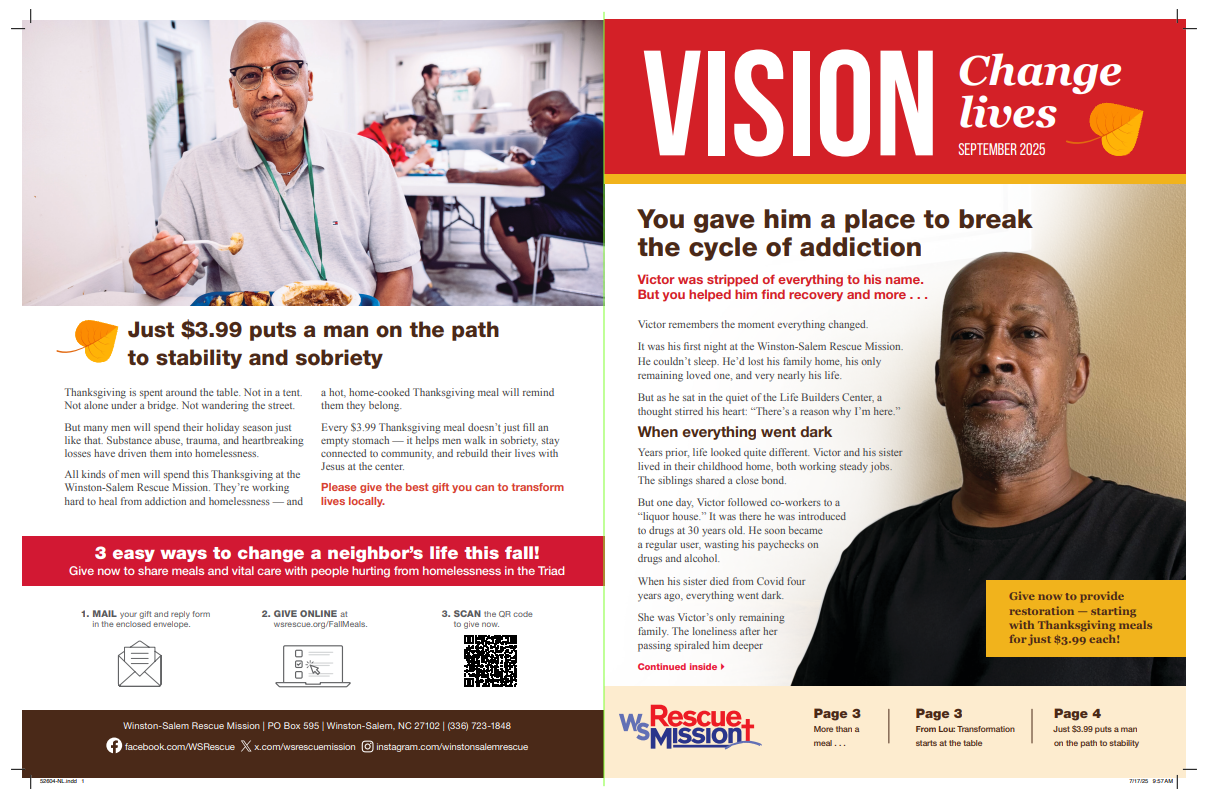
Newsletter / Winston-Salem Rescue Mission / 2025
A Story of Recovery
Context
I wrote the cover article for the September edition of Vision, the Mission's donor newsletter produced by Masterworks. The newsletter goes to donors across the Triad who already believe in the work and want to see how their giving is changing real lives in their community.
Challenge
The cover article needed to help donors understand the deeper impact behind their support — not just meals served, but the life-changing work happening through the Mission's addiction recovery program. The challenge was to honor Victor's story with dignity, connect it clearly to the Mission's Gospel-centered purpose, and write in a way that would strengthen donor trust and engagement.
Approach
During the Mission's transition to a new direct marketing partner, I stepped in to fill a critical content gap for the newsletter. I interviewed Victor, developed the cover story, and provided direction for staff photography so his story could be told with clarity and dignity. The final article was refined through collaborative editing with Masterworks, with my final review and approval before publication. I let Victor speak in his own words wherever I could, took meticulous notes, and shaped the article in a way that was easy to read while preserving the Gospel-centered framing the Mission lives by.
Direct Mail / Trellis Supportive Care / 2019
A Day at the Ballpark: Fall Appeal
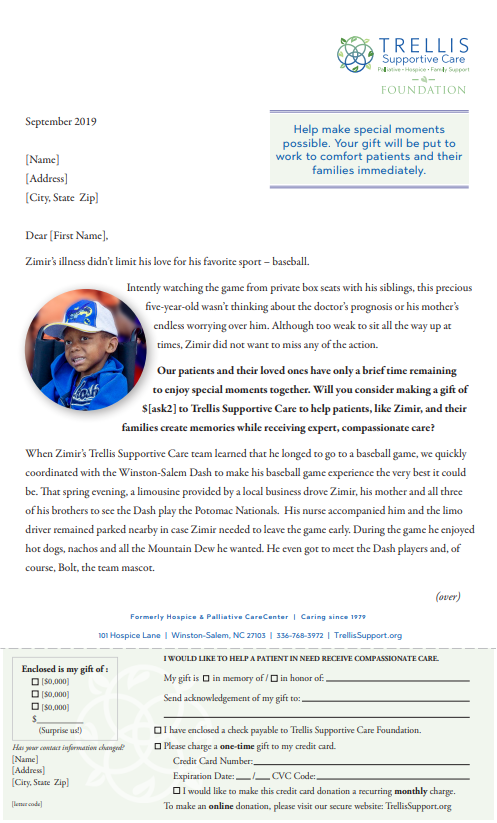
Direct Mail / Trellis Supportive Care / 2019
A Day at the Ballpark: Fall Appeal
Context
I wrote this fall appeal for the Trellis Supportive Care Foundation, the philanthropic arm of the hospice and palliative care organization that has served the Triad since 1979. The letter went to individual donors across the counties Trellis serves and was timed to land before year-end giving kicked into full gear.
Challenge
Hospice fundraising carries a quiet difficulty. Donors know the work matters, but the subject is heavy, and an appeal that leans too hard on grief loses the very people you need to reach. I had to write something honest about end-of-life care that a reader would actually finish.
Approach
I built the letter around Zimir, a five-year-old patient who loved baseball, and the evening his Trellis team coordinated with the Winston-Salem Dash so he could see a game with his mother and brothers. The lead opens on his joy rather than his diagnosis, which lets the reader stay in the story long enough to feel what supportive care actually makes possible. I kept the ask plain and tied it to the moment in front of the donor: a gift that helps another family hold onto memory in the time they have left. Dr. Lalor signed it as Chief Medical Officer, which gave the clinical credibility room to sit alongside the warmth of the story.
Grant Proposal / Mountain Valley Hospice / 2022
A Second Vehicle for Hospice Patients
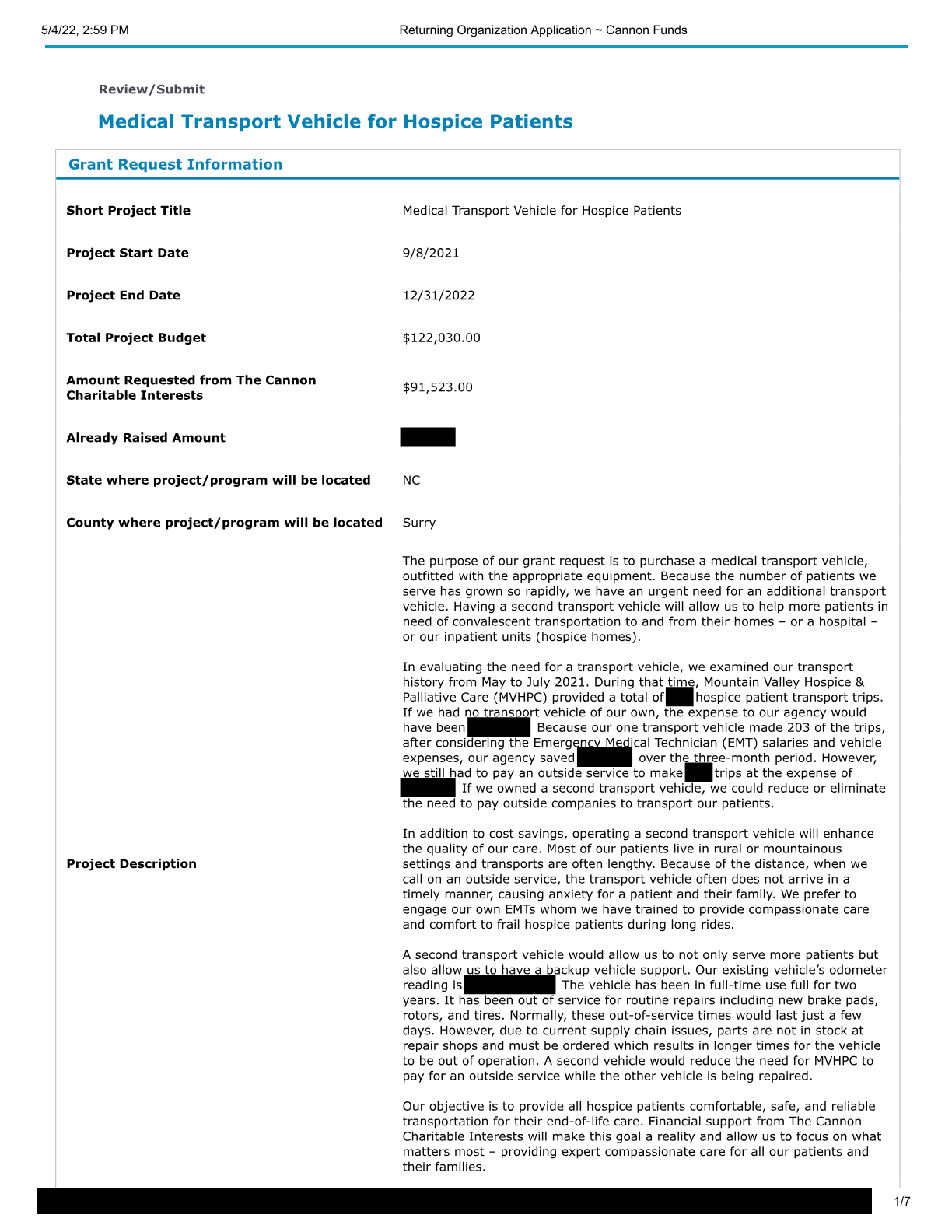
Grant Proposal / Mountain Valley Hospice / 2022
A Second Vehicle for Hospice Patients
Context
I wrote this fully funded proposal to The Cannon Charitable Interests on behalf of Mountain Valley Hospice & Palliative Care. The request was for $91,523 toward a $122,030 capital purchase: a second medical transport vehicle to serve hospice patients across the 18 rural counties covered in North Carolina and Virginia.
Challenge
The case had to make a vehicle feel like care, and it had to do that for a sophisticated funder reading dozens of applications. Supply chain delays on the chassis order added a second layer of difficulty, since I needed to be transparent about timing without letting uncertainty undercut the urgency of the need.
Approach
I led with the patient experience. Long rides through rural and mountainous terrain are anxious by nature for a frail hospice patient, and an outside transport service does not always arrive on time. From there I built the financial case using three months of our actual transport data, showing both the savings the existing vehicle had already generated and the outside costs a second vehicle would eliminate.
Grant Proposal / Winston-Salem Rescue Mission / 2026
Mental Health Counselor for Men in Recovery
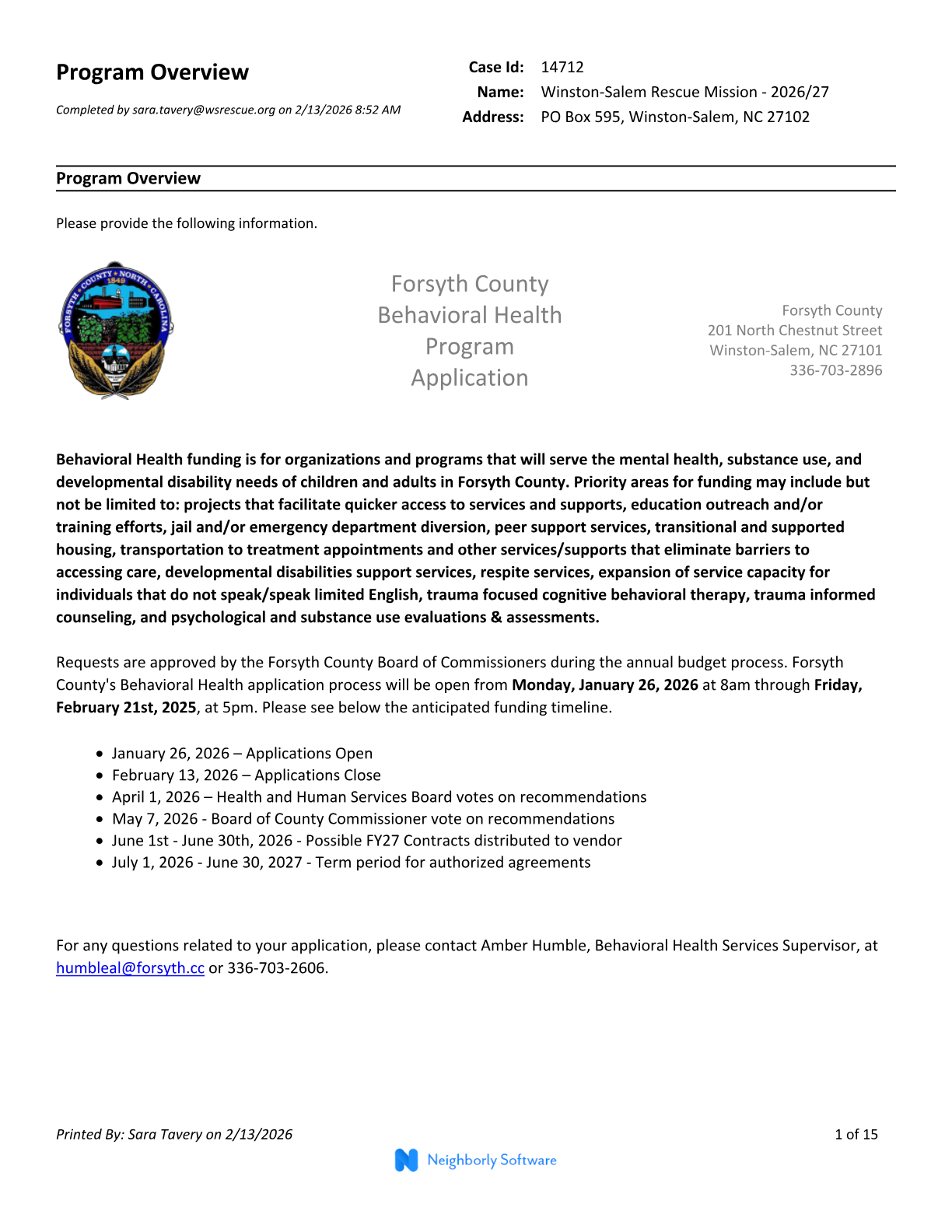
Grant Proposal / Winston-Salem Rescue Mission / 2026
Mental Health Counselor for Men in Recovery
Context
I wrote this application to Forsyth County's Behavioral Health Program for FY 2026/27 in my role as Director of Development at the Winston-Salem Rescue Mission. The $60,000 request would fund a full-time, licensed mental health counselor inside our residential addiction recovery programs for men, a clinical role the Mission had never carried on staff before.
Challenge
I had to make the case that hiring one full-time licensed mental health counselor would meaningfully change recovery client outcomes inside a faith-based recovery program, while documenting evidence-based practices, sustainability without government or private insurance reimbursement, and measurable performance targets at the level a County board expects.
Approach
I framed the role as an expansion of clinical capacity rather than a new program, which kept the proposal aligned with the priority area for psychological and substance use evaluations and assessments. The need section grounded co-occurring mental health disorders in national prevalence data and tied it directly to the men we serve. I named the specific evidence-based practices the counselor would use and set quantitative and qualitative targets the County could verify.
A Final Thought